
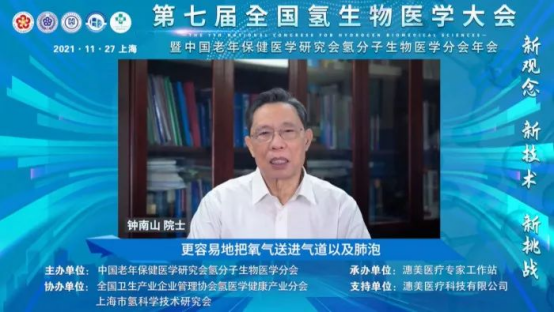
On November 27th, the “Seventh National Hydrogen Biomedicine Conference”, which broke multiple historical records, came to a perfect conclusion.
Academician Zhong Nanshan of the Chinese Academy of Engineering served as the chief consultant for the conference, and Director Xia Zhaofan, an academician of the Chinese Academy of Engineering and director of the All-Army Burn Research Institute, served as the honorary chairman of the conference.
At the same time, the conference invited academician of the Chinese Academy of Engineering, Dean of the Faculty of Forensic Medicine of Hebei Medical University Cong Bin, academician of the Chinese Academy of Engineering, Professor Ding Wenjiang of Shanghai Jiaotong University, academician of the Chinese Academy of Engineering, Professor Yang Baofeng of Harbin Medical University, academician of the Chinese Academy of Engineering, medical geneticist Professor Zeng Yitao, Academician of the Chinese Academy of Sciences, inorganic chemist Professor Ni Jiayan, academician of the Chinese Academy of Engineering, Director Fan Daiming of the PLA Institute of Digestion, Academician of the Chinese Academy of Engineering, and Professor Tang Zhaoyou, the founder of small liver cancer research, served as consultants and special guests.
The chairman of the conference was Professor Qin Shucun, chairman of the Hydrogen Molecular Medicine Branch, and experts such as Professor Sun Xuejun from Naval Military Medical University presided over the academic sharing.
At the opening ceremony of this conference, Academician Zhong Nanshan, Academician Xia Zhaofan, Academician Tang Zhaoyou, Academician Ding Wenjiang, and Academician Fan Daiming delivered speeches respectively, raising expectations for the development of hydrogen molecular medicine.
Regarding the use of hydrogen, Academician Zhong Nanshan also gave a valuable reminder. He said: “To carry out hydrogen biomedical research, equipment approved by the State Food and Drug Administration must be used, because we know that industrial hydrogen is corrosive. If industrial hydrogen is used, and its delivery system is not made of some materials that are fused with body tissues, it will corrode the metal and produce some metal impurities and produce some toxic reactions. Therefore, industrial hydrogen cannot be used casually on humans. , Or experiment on animals.”
Xia Zhaofan, academician of the Chinese Academy of Engineering and director of burns at Changhai Hospital of the People’s Liberation Army: “The hydrogen-oxygen atomizer has obtained the national innovative third-class medical device certification, which is a major breakthrough in the field of hydrogen biomedicine.”
“I hope this conference can promote my country’s hydrogen medicine research to move towards the grand vision of more innovation, more practicality, and better use for the goal of healthy aging.”
Fan Daiming, Academician of the Chinese Academy of Engineering and Director of the State Key Laboratory of Tumor Biology: “In the development of integrated medicine, hydrogen medicine may become an important tributary”
Academician Ding Wenjiang, academician of the Chinese Academy of Engineering and director of the Hydrogen Science Center of Shanghai Jiaotong University, said: “I believe that hydrogen medicine with abundant sources and broad-spectrum therapeutic effects will play an important role in supporting the national health strategy! More than ten years of research shows that, Hydrogen has a very positive biological effect on humans and even the biological world.”
Professor Tang Zhaoyou, academician of the Academy of Engineering and founder of small liver cancer research, based on years of medical research experience, put forward three requirements for the development of hydrogen biomedicine in China: “One is to start from the demand; the other is to practice meticulously; the third is Chinese characteristics.”